Introduction
In ordinary React or Vue development, front-end engineers mostly build single-page applications. Those apps do state management and partial refreshes well, and they are pleasant to work with. But when the business needs to grow through organic search traffic, the SPA hits a technical ceiling. The usual answer is to bring in Next.js or Nuxt.js.
1. What Next.js and Nuxt.js are
Next.js and Nuxt.js are isomorphic front-end frameworks built on React and Vue respectively.
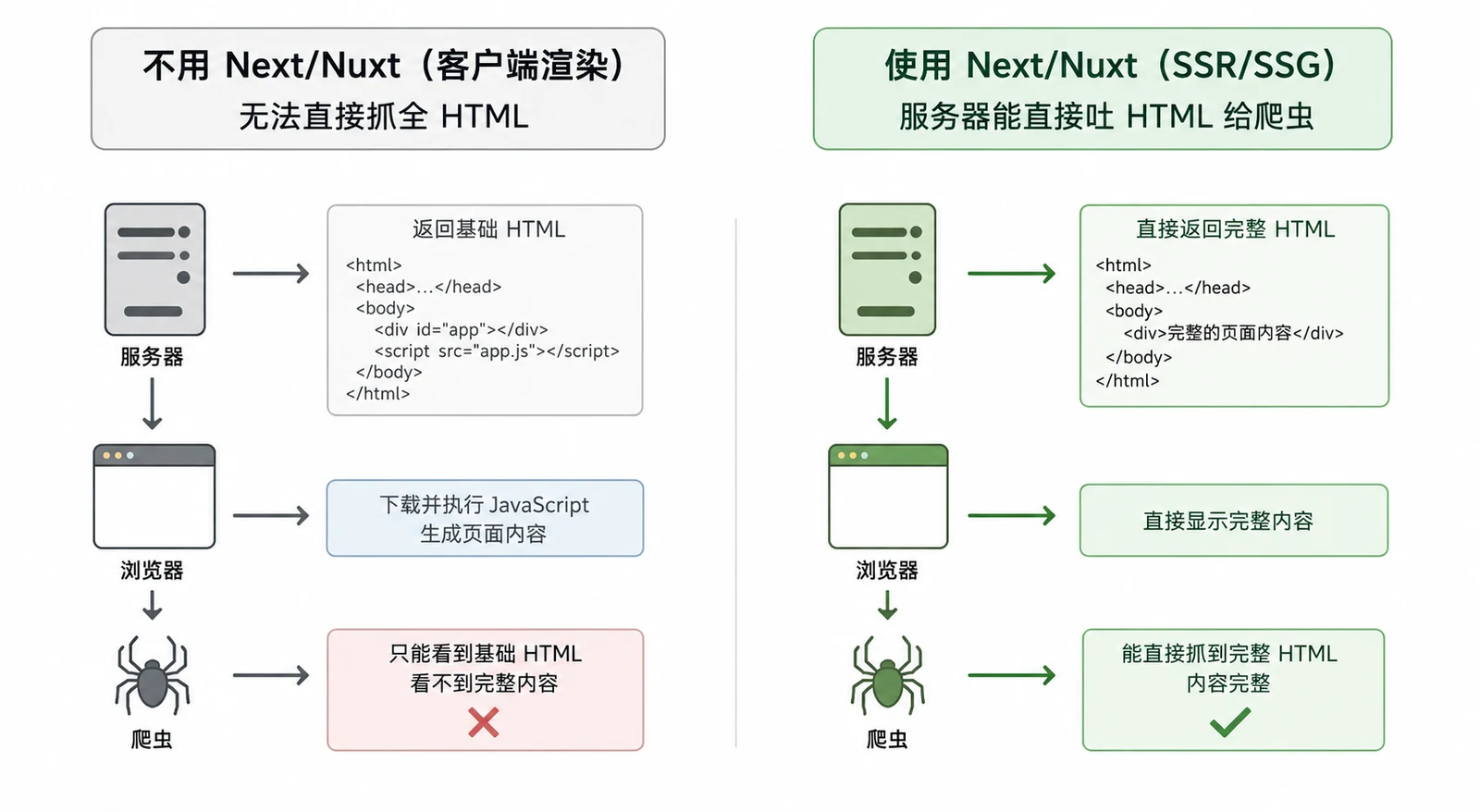
React and Vue by default render on the client: the server returns an HTML document with the basic structure, and generating every DOM node plus fetching data is left to JavaScript that the browser downloads and runs.
What Next.js and Nuxt.js add is SSR, server-side rendering, and SSG, static site generation. They move page rendering earlier — onto the server or into the build step — and hand the browser a page that already contains the complete HTML structure.
2. What they are good for
The core value of these two frameworks in engineering practice comes down to two things:
The first is search engine optimisation, SEO. When mainstream search crawlers fetch a page, their ability to handle complex JavaScript that loads data asynchronously is very limited. A traditional SPA usually looks like a blank page to a crawler, so the content never gets indexed. With server-side rendering, the crawler can read rendered structured text and links directly, which protects both indexing and ranking.
The second is a faster first paint. Because the server returns the complete HTML, the browser does not have to wait for a large JS bundle to download before it can run the rendering logic. For consumer products on constrained networks, or where core metrics like first contentful paint matter, this sharply cuts the blank-screen wait.
3. Why I recommend them
Beyond SEO and first-paint performance, both frameworks are worth adopting for engineering efficiency.
First, routing is simpler. Both use filesystem-based routing: create a file in the right directory following the convention and the route exists, which cuts the cost of maintaining a central routing table.
Second, they carry lightweight backend capability. API routes are built in, so you can write simple backend endpoints and talk to a database inside the same project — very handy for iterating quickly on small full-stack products.
Third, performance optimisation is automatic. The frameworks build in optimisations for images, fonts and third-party scripts, so you get a solid front-end performance baseline without digging into Webpack or Vite configuration.
4. Advantages and disadvantages next to Astro
In content sites and SEO, Astro has drawn a lot of attention lately. Compared with Astro, the strengths and weaknesses of Next.js and Nuxt.js are fairly clear, and which one wins depends on the product.
The advantage of Next.js and Nuxt.js is state management and complex interaction. If the product involves heavy front-end logic — a SaaS admin panel, a complicated form system, a collaborative tool — Next and Nuxt can reuse the whole React or Vue ecosystem, and developers pay almost no mental cost moving between client and server.
The disadvantage is that the build output stays heavy. Even with SSR, Next and Nuxt still have to ship framework runtime code and state data to the client to hydrate the page, which means the overall JS bundle is hard to trim to the bone.
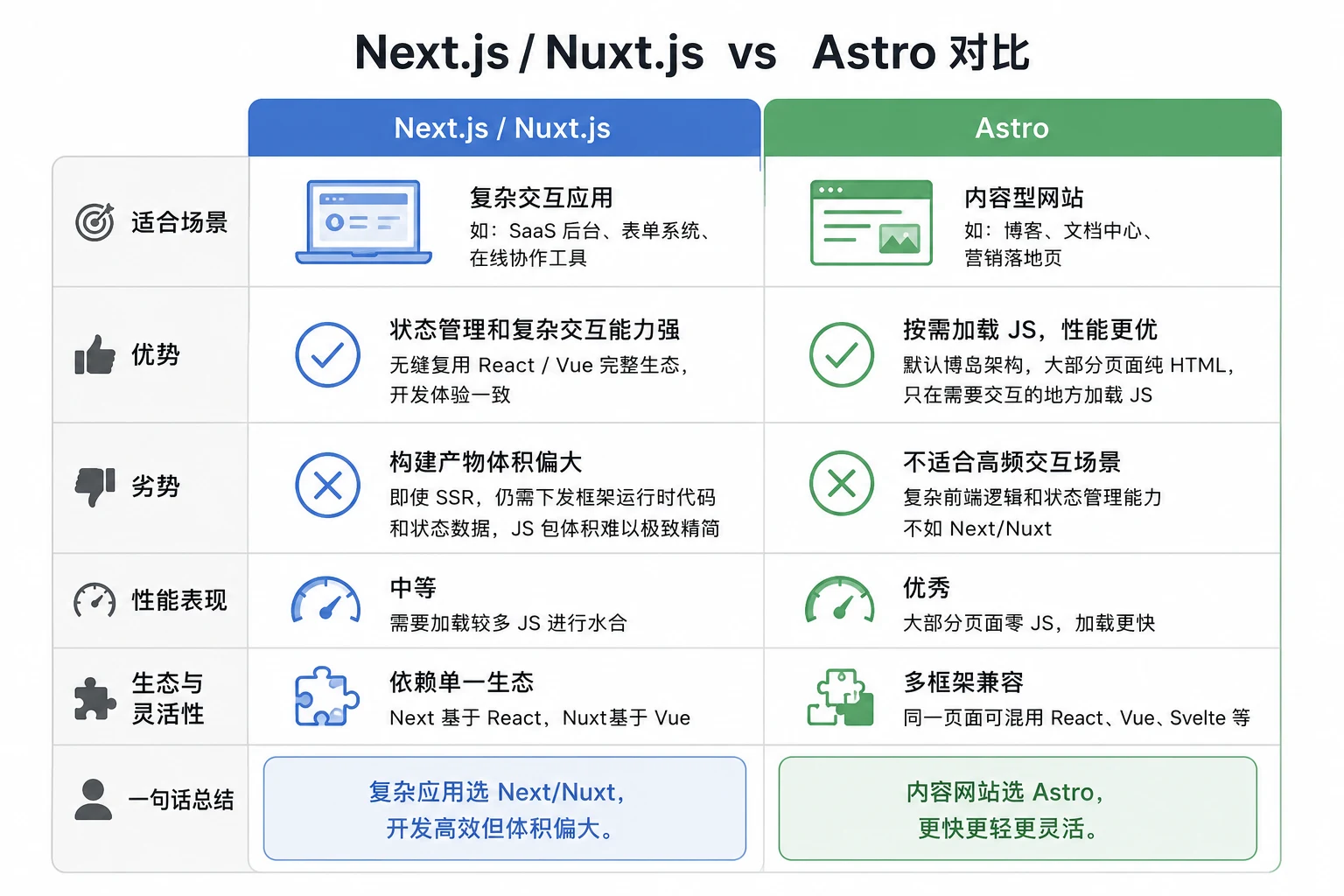
Astro's architecture is different. It uses islands by default, with the core idea of loading JavaScript on demand. Most static pages go out as plain HTML, and JS is attached only to the components that need interaction. So for blogs, documentation centres or marketing landing pages — content-heavy, interaction-light — Astro usually beats Next and Nuxt on loading performance and bundle size. On top of that, Astro lets you mix React, Vue and other frameworks' components on one page, which gives you more freedom in choosing tools.
Complex web applications with heavy interaction that still need some SEO are better served by Next.js or Nuxt.js; for content sites that are mostly static reading, Astro is the better engineering choice at this point.