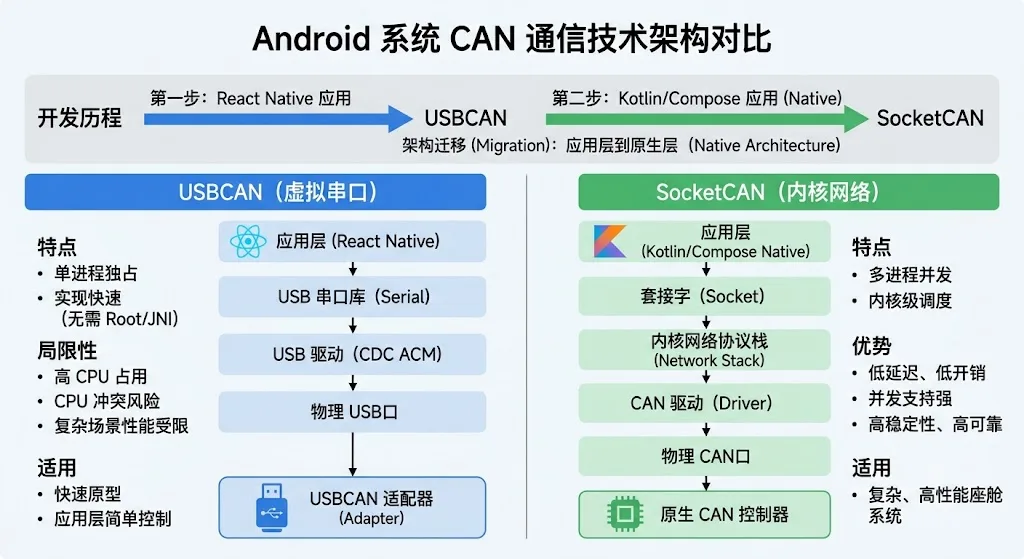
These notes compare the USB serial CAN implementation I used in an Android vehicle project with Linux SocketCAN, focusing on background listening, multi-process access and device identification. Here, USBCAN means that project's virtual serial implementation. Some USB-CAN adapters have SocketCAN drivers, so the connector alone does not distinguish the approaches.
1. USB serial CAN and SocketCAN
The initial implementation used Android's USB serial interface and a serial protocol similar to SLCAN to exchange CAN frames. With a supported board and device interface, this made it possible to test the idea without first customising the kernel CAN driver for that adapter.
SocketCAN represents a CAN controller as a Linux network interface such as can0. Applications exchange frames through CAN sockets, and several sockets can bind to one interface with receive filters. An Android device still needs the appropriate kernel driver, interface configuration and application permissions; choosing Kotlin does not supply them automatically.
2. Why this project considered migration
The initial goal was to test offline voice control of body hardware quickly on an unmodified Android development board. Later, a background listener needed to receive reversing messages and update the interface. That exposed several problems in the original implementation.
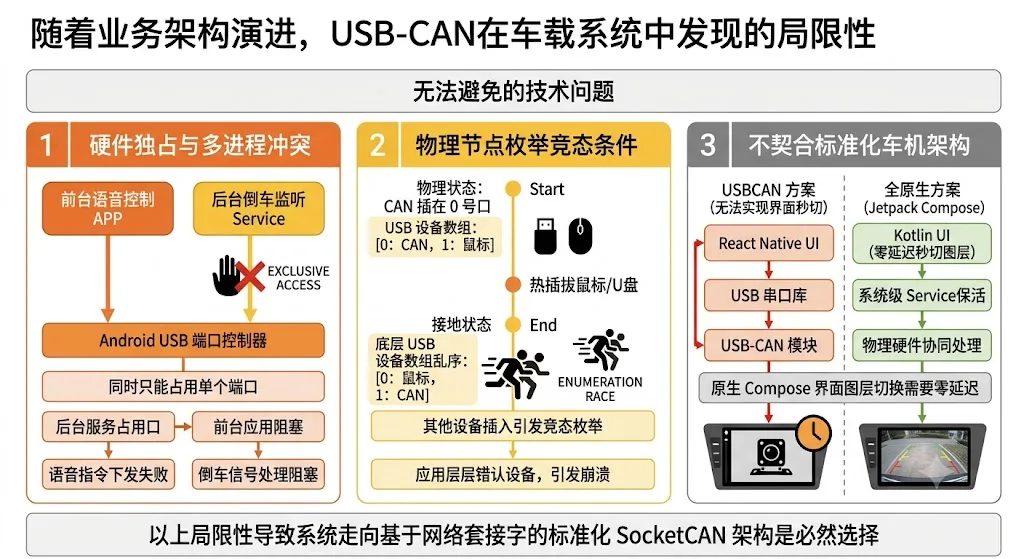
- Coordinating access: the foreground application held the serial connection, and a separate background service opening the same device caused conflicts. This describes the existing connection management, rather than every Android USB device. SocketCAN's multiple sockets make separate receivers convenient; transmission arbitration, bus load and shared state still need design.
- Device identification: the old implementation relied on enumeration order and could select the wrong device after other USB peripherals were connected. Device identifiers, interface information and connection state need to identify the target. A fixed onboard CAN controller removes that particular USB path, but
can0does not guarantee an uninterrupted connection. USB SocketCAN adapters still depend on USB and driver state. - Background and UI responsibilities: the project planned to use Kotlin, a Service and Jetpack Compose to separate message listening from UI state. That helps manage lifecycles, but it is a project choice rather than a SocketCAN requirement or a guarantee of zero latency.
3. What to verify during migration
Check drivers, CAN bitrate, interface permissions and frame filters, then exercise continuous listening, foreground/background transitions, reconnection and multi-process traffic. Measure response time and stability on the actual hardware under bus load. Using SocketCAN does not establish automotive certification.
See the Linux kernel SocketCAN documentation for the interface mechanisms. Related Android project notes cover MediaPipe gestures and CameraX pitfalls and the ML Kit fatigue-detection prototype.